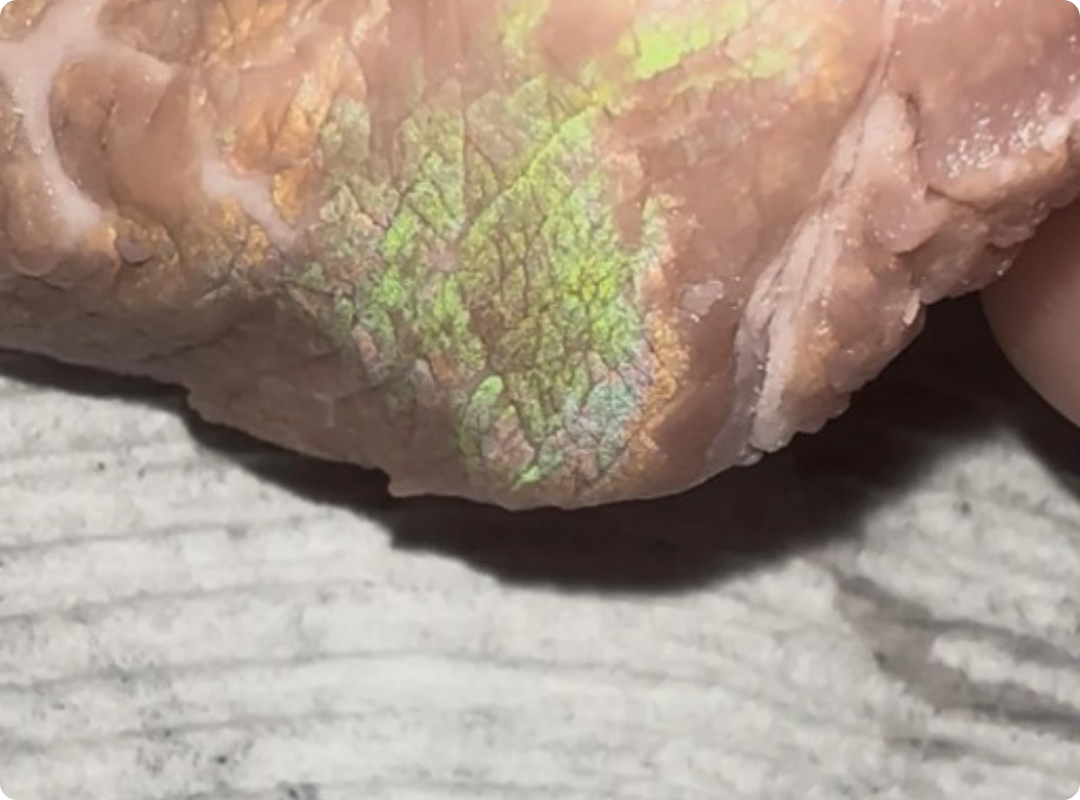
You open the fridge, reach for a slice of roast beef—and freeze. Gleaming across its surface: a shimmering arc of emerald, gold, and violet, like oil on water or a hummingbird’s throat in sunlight. Your mind races: Is this safe? Did it go bad? Did someone… dye it?
Relax. That iridescence isn’t spoilage. It’s not magic. It’s science—a quiet, dazzling dance of light and structure happening on your deli meat, and it’s completely harmless.
🔬 The Why: When Meat Becomes a Prism
Meat isn’t a uniform slab—it’s a tightly woven tapestry of muscle fibers, aligned like piano strings. When deli meats (especially whole-muscle cuts like roast beef, corned beef, or turkey breast) are sliced across the grain, those fibers are cleanly severed, creating microscopic ridges on the surface—think of them as nature’s diffraction grating.
Now, enter light:
→ White light (from your kitchen bulb or the sun) hits these ridges.
→ The grooves split the light into its component wavelengths—just like a prism.
→ Different wavelengths (colors) reflect at slightly different angles.
→ Your eyes perceive this as shifting iridescence: rainbow meat.
This phenomenon—structural coloration—is the same physics behind:
- Peacock feathers
- Butterfly wings
- The sheen of a CD
It’s light playing tricks, not decay.
🥩 Why Some Meats Shine (and Others Don’t)
|
Prone to Rainbows
|
Unlikely to Shine
|
|---|---|
|
Whole-muscle deli meats (roast beef, pastrami)
|
Ground meats (hamburger, sausage)
|
|
Sliced against the grain
|
Restructured meats (bologna, some hams)
|
|
Darker meats (beef, corned beef)
|
Pale meats (chicken, turkey—colors are there, but harder to see)
|
The darker the meat, the more dramatic the effect—deep reds and browns provide the perfect backdrop for light to refract.
✅ Is It Safe? Absolutely.
This iridescence is purely optical. It has zero connection to:
- Bacterial growth
- Spoilage
- Chemical contamination
- Freshness (shiny meat can be fresh; dull meat can be past its prime)
If your meat smells sour, feels slimy, or shows green/black mold? Then it’s time to toss it. But a rainbow sheen? That’s just physics saying hello.
🌈 To Hide or Embrace the Glow?
While you can’t eliminate it (it’s built into the slice), you can minimize visibility:
- Store deli meat in opaque containers (blocks light exposure)
- Keep slices tightly wrapped (reduces surface oxidation that can enhance sheen)
- Serve on dark plates (contrasts less than white)
But here’s a better idea: celebrate it.
That shimmer is a testament to craftsmanship—the precise cut of a skilled butcher, the integrity of whole-muscle meat, the quiet wonder of natural physics at your fingertips. It’s food as art, science, and sustenance—all in one slice.
In a world of ultra-processed foods and artificial colors, there’s profound beauty in a phenomenon this honest: no additives, no tricks—just muscle, light, and the elegant laws of nature.
So next time your roast beef glows like an opal, don’t flinch.
Pause. Lean in.
And take a moment to marvel at the quiet miracle on your plate—
before building the most scientifically spectacular sandwich of your life.