
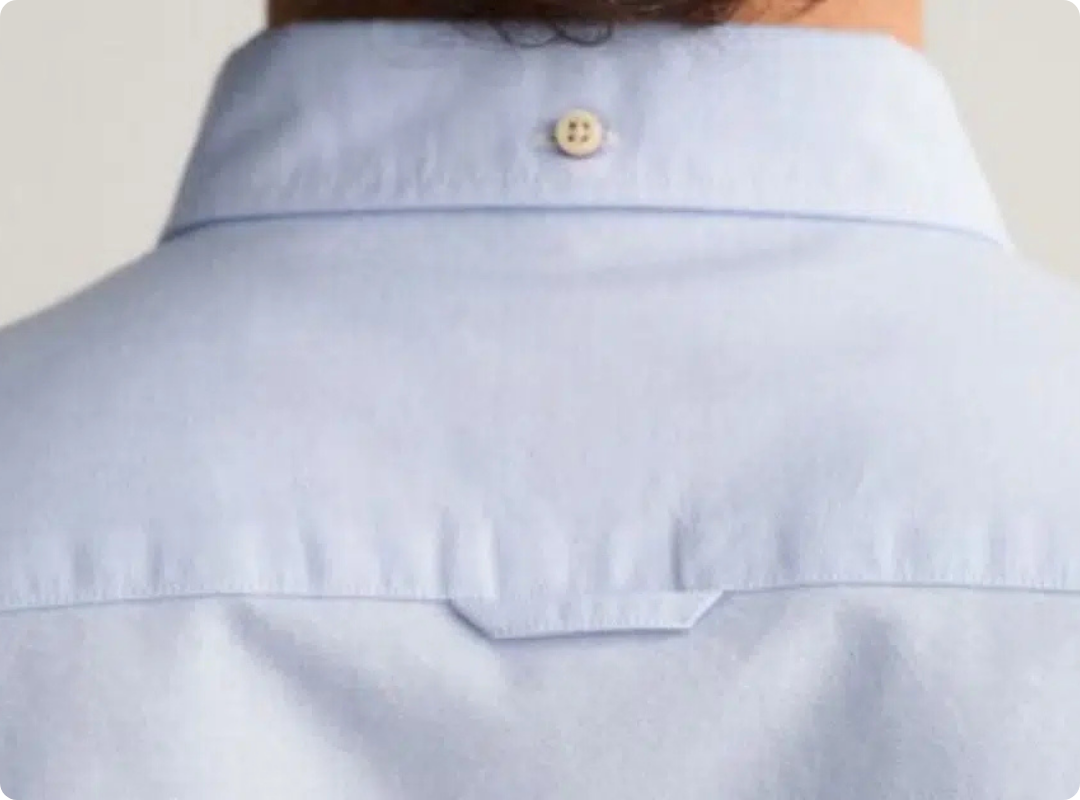
You’ve probably felt it—a tiny tab of fabric brushing the back of your neck just below the collar of certain button-down shirts. Maybe you’ve never even noticed it. But if you take a closer look, you’ll find a small, unassuming loop stitched into the yoke. It’s so subtle that many wearers go years without realizing it’s there—including my husband, who stared at his own shirts in genuine surprise when I pointed it out.
For the longest time, I assumed it was just a random leftover from the sewing process—some meaningless factory quirk. But as it turns out, this little loop has a surprisingly rich backstory—one that begins not on fashion runways, but aboard U.S. Navy ships over a century ago.
From Naval Necessity to Ivy League Icon
In the early 1900s, sailors lived in tight, chaotic quarters with no closets, hangers, or luxury of space. Their dress uniforms needed to stay crisp, clean, and off the damp deck. Enter the “locker loop” (also called a “backstay loop”). This simple fabric loop allowed sailors to hang their shirts on hooks or pegs—keeping them wrinkle-free and ready for inspection. No hangers required. Just a hook, a loop, and a bit of ingenuity.
It was brilliant in its simplicity: no high-tech solution, no complex mechanism—just a stitch of fabric that solved a real problem in a very real environment.
But then something unexpected happened.
By the mid-20th century, the loop migrated from ship decks to college campuses—particularly the Ivy League. Students, far removed from naval life, began wearing oxford button-downs adorned with these loops. Except now, they weren’t hanging shirts in lockers. They were wearing them as a style statement.
The loop became a quiet nod to classic American prep: clean, understated, and subtly distinguished. Paired with khakis, loafers, and crewneck sweaters, it signaled a certain kind of effortless polish. Designers took notice—and soon, the loop was less about function and more about heritage.
A Detail That Endured Beyond Its Purpose
Even after its original use faded, the loop stuck around. Why? Because it had become part of the language of menswear. Brands began incorporating it not out of necessity, but as a signature touch—a whisper of tradition in an otherwise modern garment.
Some designers even play with it: contrasting thread, colored fabric, or embroidered initials turn the humble loop into a subtle badge of identity. For true style enthusiasts, spotting a well-placed loop is like recognizing a secret handshake.
And here’s the kicker—it’s still practical, even today.
Travelers, take note: that little loop is perfect for hanging your shirt on a hotel bathroom door, a coat rack, or even inside a garment bag. No hanger? No problem. It helps minimize wrinkles when you’re living out of a suitcase—proving that sometimes, old solutions still work beautifully in modern life.
A Quirky Side Note: The “Taken” Myth
While digging into this history, I stumbled upon a charming (if dubious) urban legend: decades ago, some college guys supposedly cut off the loop to signal they were in a relationship. No loop = taken. Their girlfriends, in turn, would wear their school pin as a matching token. Sweet? Absolutely. Slightly possessive? Perhaps. While there’s no hard evidence this was widespread, it adds a playful layer to the loop’s lore—proof that even small details can carry emotional weight.
So What Does It Mean Today?
If your shirt has a loop, it likely says more about the brand’s aesthetic than your storage needs. Some labels—like Brooks Brothers or J.Crew—consistently include it as a mark of classic tailoring. Others omit it entirely for a cleaner, minimalist look. But whether you use it or not, the loop remains a quiet heirloom of design evolution: born from naval pragmatism, adopted by campus trendsetters, and preserved by generations who appreciate the poetry of functional elegance.
Now, when you slip on a button-down and feel that soft tab against your neck, you’re not just wearing a shirt—you’re carrying a piece of history. And who knows? Next time you’re packing for a trip, you might just hang it by that loop… and give a silent thanks to the sailors who started it all.