
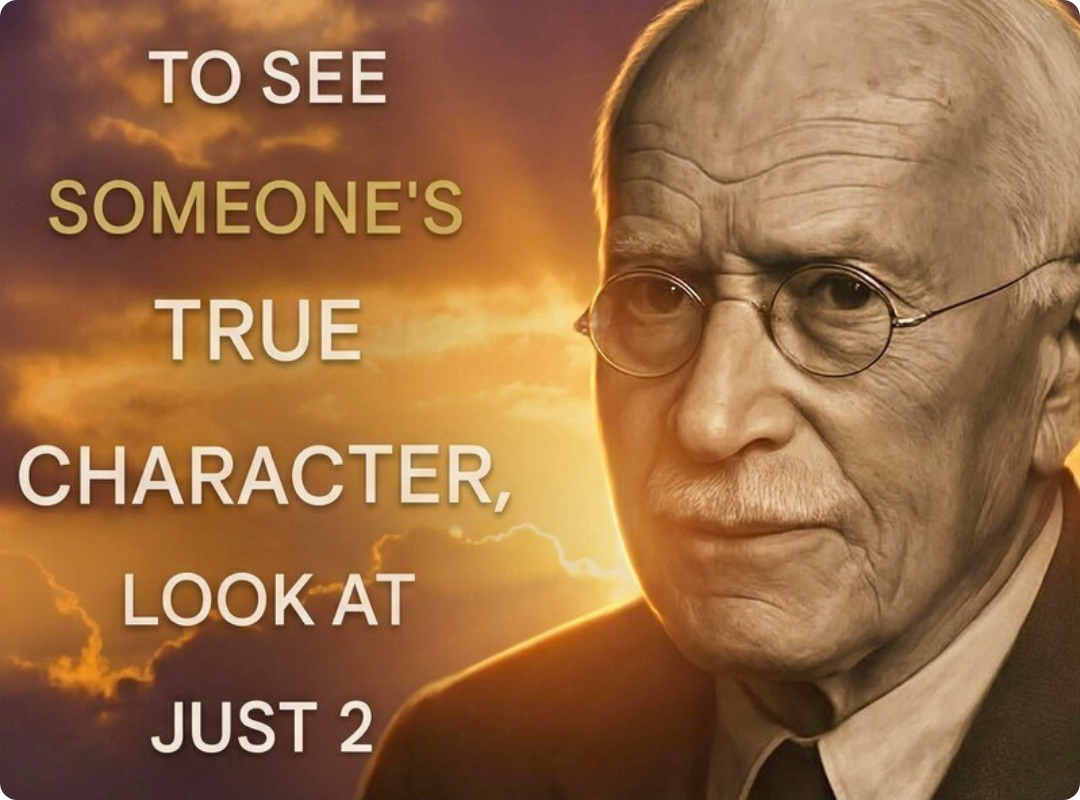
We spend lifetimes learning to read people—decoding words, weighing promises, scanning for sincerity. Yet according to Carl Jung, the pioneering Swiss psychiatrist and founder of analytical psychology, profound insight requires neither years nor expertise. It demands only mindful attention to two unguarded moments.
Jung believed character is not revealed in curated performances or moments of ease, but in the quiet choices made when no reward is offered and no audience is watching.
The First Window: How They Treat Those Who Hold No Power
Watch how someone engages with the barista, the custodian, the delivery driver—the individuals whose roles hold no social leverage. Do they offer eye contact, a genuine “thank you,” patient grace? Or impatience, invisibility, condescension?
This is not about politeness as performance. It is about empathy as instinct. Kindness extended without expectation of return reflects a deeply rooted integrity. Dismissiveness reveals not superiority, but a fragility that requires hierarchy to feel secure.
As Jung observed: “The measure of a soul is found not in how it treats equals, but in how it honors the unseen.”
The Second Window: How They Navigate Frustration
When plans collapse, technology fails, or delays mount—what emerges? Do they take a breath, seek solutions, extend grace to others? Or deflect blame, erupt in sharp words, fracture under pressure?
These moments are character’s crucible. They reveal emotional maturity, humility, and the quiet strength of self-regulation. Jung emphasized: Character is not forged in comfort, but in crisis. How someone handles friction—without an audience to impress—speaks volumes about their inner architecture.
Complementary Insights (Without Judgment)
While Jung centered these two behaviors, thoughtful observation often includes:
- Humor: Does it uplift, include, and invite joy? Or cut, exclude, and mask insecurity?
- Speech about others: Consistent criticism or gossip often reflects inner unrest; compassion reflects inner peace.
- Listening presence: True listening—without interruption or redirection—is a quiet act of respect.
- Use of influence: How someone wields even small authority reveals whether power serves ego or others.
These are not tools for condemnation, but compasses for understanding.
A Gentle Reminder
This lens is not meant to judge others harshly—but to cultivate discernment with compassion. We all have moments of impatience, fatigue, or misstep. True character is revealed not in perfection, but in patterns. In the consistent return to kindness after a stumble. In the humility to apologize. In the quiet choice to do right when no one is watching.
And in turning this gaze inward, we find the deepest gift of Jung’s wisdom:
The same windows we use to see others clearly become mirrors for our own growth.
The same windows we use to see others clearly become mirrors for our own growth.
Character is not a destination.
It is the accumulation of small, unseen choices—
made with intention,
honored with grace,
and witnessed by those who know where to look.
It is the accumulation of small, unseen choices—
made with intention,
honored with grace,
and witnessed by those who know where to look.