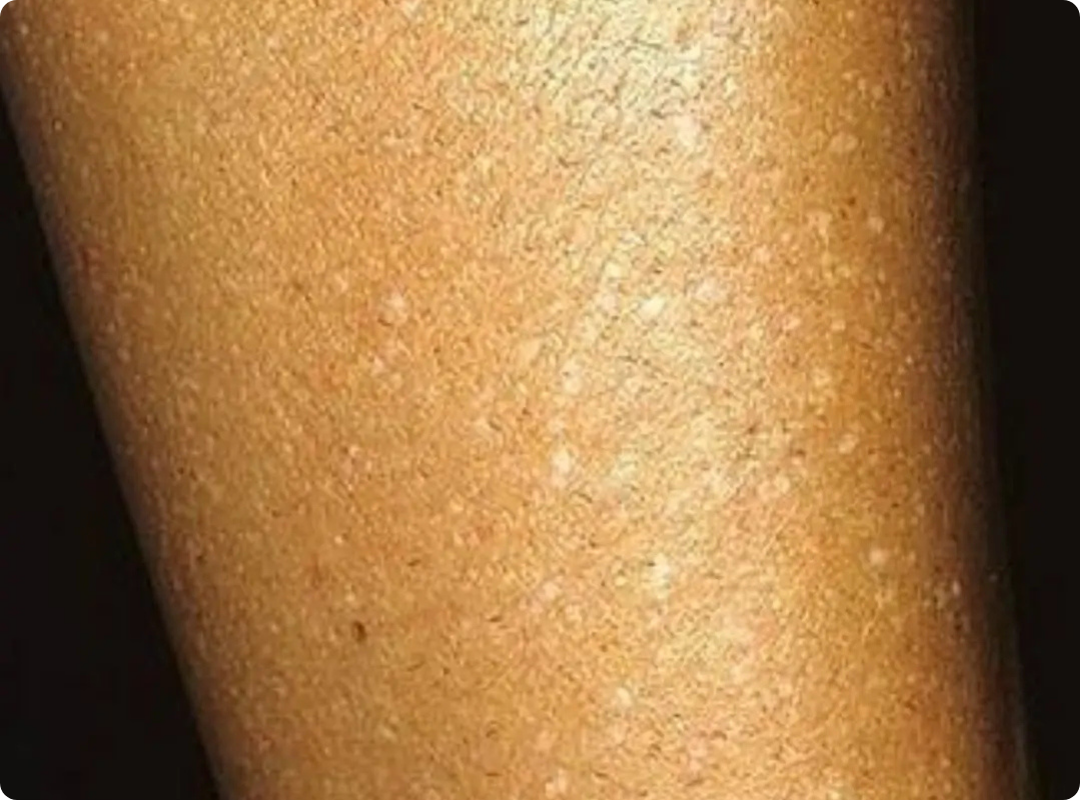
If you’ve ever caught a glimpse of your arms or legs in natural light and noticed tiny, pale dots speckling your skin—especially as your summer glow begins to fade—you’re far from alone. These small, porcelain-white marks often become more noticeable against slightly tanned or naturally pigmented skin, standing out like delicate snowflakes on a sun-kissed canvas. For many people, they seem to appear gradually over the years, sometimes increasing in number with age, and can spark curiosity—or even mild concern.
You might have wondered: Are these spots a rash? A fungal infection? A sign of something more serious? The good news is that, in the vast majority of cases, these marks are completely benign. Dermatologists have a name for them: idiopathic guttate hypomelanosis, or IGH for short—and they’re far more common than you might think.
What Exactly Is IGH?
Idiopathic guttate hypomelanosis refers to small, flat, smooth, white or off-white spots that measure just 2 to 5 millimeters in diameter—about the size of a pinhead or a pencil tip. The term itself breaks down like this:
- Idiopathic: Of unknown cause (though we now have strong theories)
- Guttate: Meaning “drop-like” in shape
- Hypomelanosis: A reduction in melanin, the pigment that gives skin its color
These spots are not raised, scaly, itchy, or painful. They simply lack pigment in localized areas, making them appear lighter than the surrounding skin. While they’re most commonly seen on sun-exposed areas—particularly the forearms, shins, lower legs, and sometimes the face or shoulders—they rarely appear on the torso or areas shielded from the sun.
IGH can affect people of all skin tones and ethnic backgrounds, though they tend to be more visible on individuals with medium to darker complexions, where the contrast between pigmented and depigmented skin is more pronounced.
Why Do These Spots Develop?
While the exact mechanism isn’t fully understood, dermatologists widely agree that chronic sun exposure plays a central role. Over time, UV radiation can damage or deplete the melanocytes—the specialized skin cells responsible for producing melanin. In areas that receive repeated sun exposure (like your arms and legs), these cells may become less efficient or stop functioning altogether in small patches, leading to tiny zones of pigment loss.
Aging is another key factor. IGH is rare in children and young adults but becomes increasingly common after age 40. By age 50, many people have at least a few spots; by 70, they’re nearly universal in sun-exposed populations. In this sense, IGH is less a medical condition and more a natural sign of skin aging—akin to fine lines, age spots, or thinning skin.
It’s worth noting that IGH is not contagious, not linked to autoimmune disorders (like vitiligo, which causes larger, irregular patches of depigmentation), and not a precursor to skin cancer. Unlike conditions such as tinea versicolor (a fungal infection that also causes white spots), IGH doesn’t respond to antifungal treatments and doesn’t flake, itch, or spread rapidly.
Should You Be Concerned?
In almost every case—no. IGH is considered a cosmetic concern only, not a medical one. It doesn’t cause discomfort, doesn’t worsen into anything dangerous, and doesn’t require treatment unless it bothers you aesthetically.
That said, if you notice any of the following, it’s wise to consult a dermatologist for proper evaluation:
- Spots that are itchy, scaly, or inflamed
- Patches that grow rapidly or change shape
- Large, irregular white areas (which could indicate vitiligo)
- Spots that appear in unusual locations (like the mouth, genitals, or inside the nose)
A dermatologist can usually diagnose IGH with a simple visual exam or a tool called a dermatoscope, which magnifies the skin’s surface. In rare cases, a biopsy may be performed to rule out other conditions—but this is uncommon.
Can You Prevent or Treat IGH?
While you can’t reverse existing spots, you can slow the development of new ones by practicing consistent sun protection:
- Apply a broad-spectrum sunscreen (SPF 30 or higher) daily to exposed skin—even on cloudy days
- Wear long sleeves, wide-brimmed hats, and UV-protective clothing during peak sun hours
- Avoid tanning beds, which accelerate skin aging and pigment changes
As for treatment, most people choose to leave IGH alone. However, if the appearance is bothersome, options like cryotherapy (freezing), laser therapy, or topical retinoids have been used with limited success—but results are unpredictable, and insurance rarely covers these cosmetic procedures.
A Natural Part of Your Skin’s Story
Ultimately, idiopathic guttate hypomelanosis is less a flaw and more a silent map of your life in the sun. Each tiny spot tells a story of beach days, hikes, gardening, or simply living outdoors—moments that shaped your experiences and, quite literally, your skin.
Rather than viewing them as imperfections, many people come to accept these little marks as gentle reminders of time well spent. After all, they’re not a sign of illness—they’re a testament to living.
So the next time you notice those pale specks on your arms or legs, take a breath. They’re almost certainly just IGH: harmless, common, and nothing to fear. Your skin is doing exactly what skin does—it’s aging, adapting, and reflecting the life you’ve lived. And that, in itself, is beautiful.