It started with a lazy evening: pasta simmering on the stove, phone in hand, scrolling through the Dull Men’s Club Facebook group (a treasure trove of oddly fascinating observations). Then—a photo stopped me mid-scroll.
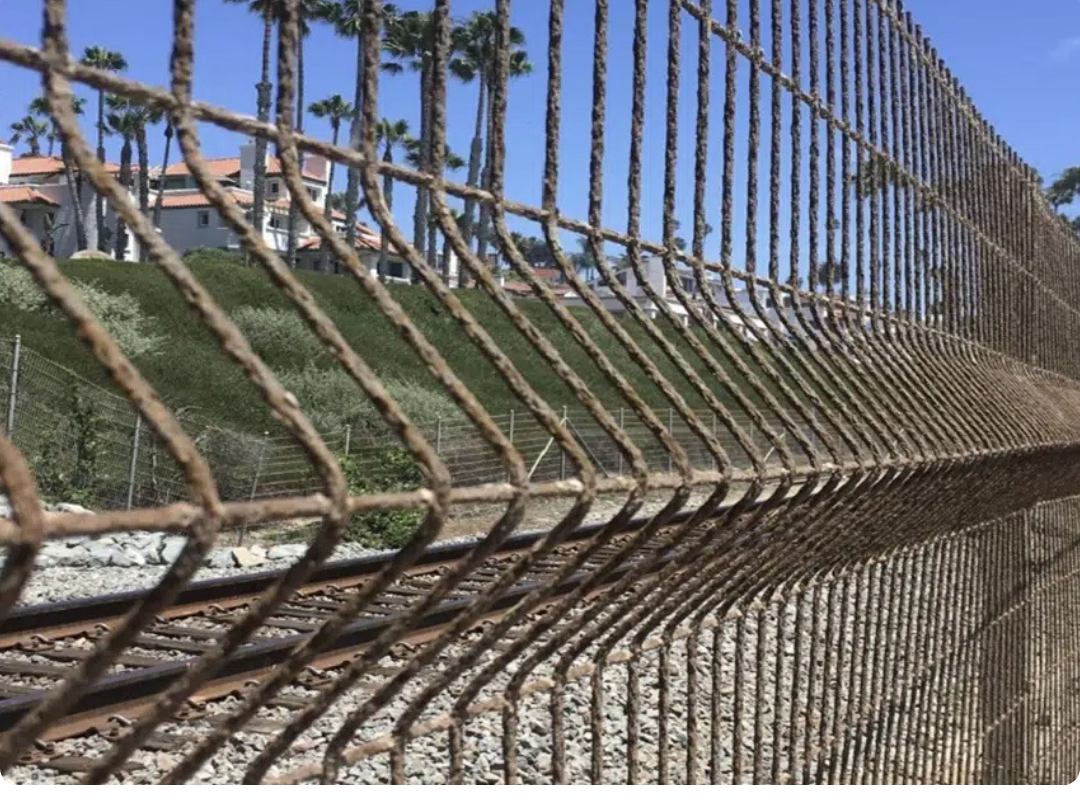
A fence. Along train tracks in San Clemente, California. But not just any fence. This one bent outward halfway up—zigzagging in a deliberate, almost artistic kink, like a wave frozen in metal.
“Why is it crooked?” the post asked. “What’s the point? Seems like it’d cost more. Did someone mess up?”
I showed it to my husband. He paused mid-stir. “Huh. That is weird.”
And just like that—what looked like a construction flaw became a rabbit hole of engineering ingenuity.
Because here’s the truth: that bend isn’t a mistake. It’s a masterpiece of preventative design.
🔒 Meet the Anti-Climb Fence: Safety, Sculpted in Steel
You’ve seen them—along railways, near substations, around secure facilities. The fence stands tall, then, about chest-high, it flares outward in a sharp, angled curve. It’s not rust. It’s not warping in the sun. It’s precision-bent—and it has one mission: to stop you before you even try.
How It Works—Physics as a Guardian
Imagine climbing a straight fence. Challenging, yes—but with grip, leverage, and determination, possible.
Now imagine reaching that curve. The fence leans toward you. To keep climbing, you’d have to:
→ Arch your back against gravity
→ Lose contact with the vertical support
→ Balance precariously over a drop
It’s biomechanically awkward. Instinctively, your body says: This is unsafe. Abort.
That’s the genius. It doesn’t rely on spikes or electrification. It uses human physiology as its first line of defense.
🚂 Why Railways Need This—Especially by the Beach
Train tracks near pedestrian zones—like San Clemente’s famed coastal route—are high-risk zones. Tourists dash across for sunset photos. Kids chase balls. Locals take “quick shortcuts” over the rails.
But trains don’t stop on a dime. At 55 mph, a freight train needs a mile to halt. There is no “duck and cover.” There is only don’t be there.
These fences aren’t about keeping people out of an area. They’re about keeping people alive—by making the first step feel wrong, long before danger is visible.
❓ Why Not Just Build It Taller?
A fair question. But height brings its own problems:
- Cost: Doubling height can triple material and foundation expenses.
- Views: In scenic corridors (like oceanfront trails), a 12-foot wall destroys the experience.
- Wind load: Taller fences act like sails—requiring heavier posts and deeper footings.
- Maintenance: Inspecting and repairing high sections is slower, riskier, and pricier.
The angled design? It achieves more deterrence with less height. A 6-foot fence with a 15-degree outward bend is harder to scale than an 8-foot straight one—and far more elegant.
💡 The Quiet Brilliance of “Slowing Down”
In high-risk environments, seconds matter. Anti-climb fences don’t need to be impossible to scale—they just need to make it take longer. That pause—those extra five seconds of hesitation—gives time for:
→ A warning shout
→ A second thought
→ A train’s horn to be heard
They’re used everywhere: prisons, power plants, subways, and border security. Why? Because they work. Studies show they reduce unauthorized access by over 70% compared to standard fencing.
🌊 Why San Clemente? The Perfect Storm of Beauty and Risk
This coastal city epitomizes the challenge:
- Tracks hug the bluffs, sandwiched between the Pacific and a popular beach path.
- Foot traffic is constant—surfers, walkers, photographers.
- The allure of the “quick crossing” is strong.
Here, the bent fence isn’t just infrastructure. It’s a silent negotiator—respecting the view while protecting lives. It says: Enjoy the ocean. Just stay on this side of the line.
✅ So—Was It a Mistake? Absolutely Not.
The next time you see that curious kink in a fence, don’t chuckle. Nod. That curve is the result of engineers, safety experts, and urban planners asking: How do we prevent harm without creating a prison?
It’s function dressed as form. Safety disguised as simplicity.
And yes—over a steaming plate of pasta that night, my husband and I agreed: some of the most profound innovations aren’t flashy.
They’re subtle, sturdy, and bent—ever so slightly—toward keeping us all safer.
Now that’s a design worth noticing.