Close your eyes. Can you still hear it? The gentle clink of glass meeting glass. The whisper of steam rising from a just-washed jar. The quiet rhythm of a kitchen where nothing was wasted—because nothing could be.
In that world, tucked beside the sink or mounted on a sunlit windowsill, stood an unassuming hero: the vintage bottle drying rack. Not merely a tool, but a testament to a time when resourcefulness wasn’t a trend—it was survival.
The Architecture of Practicality
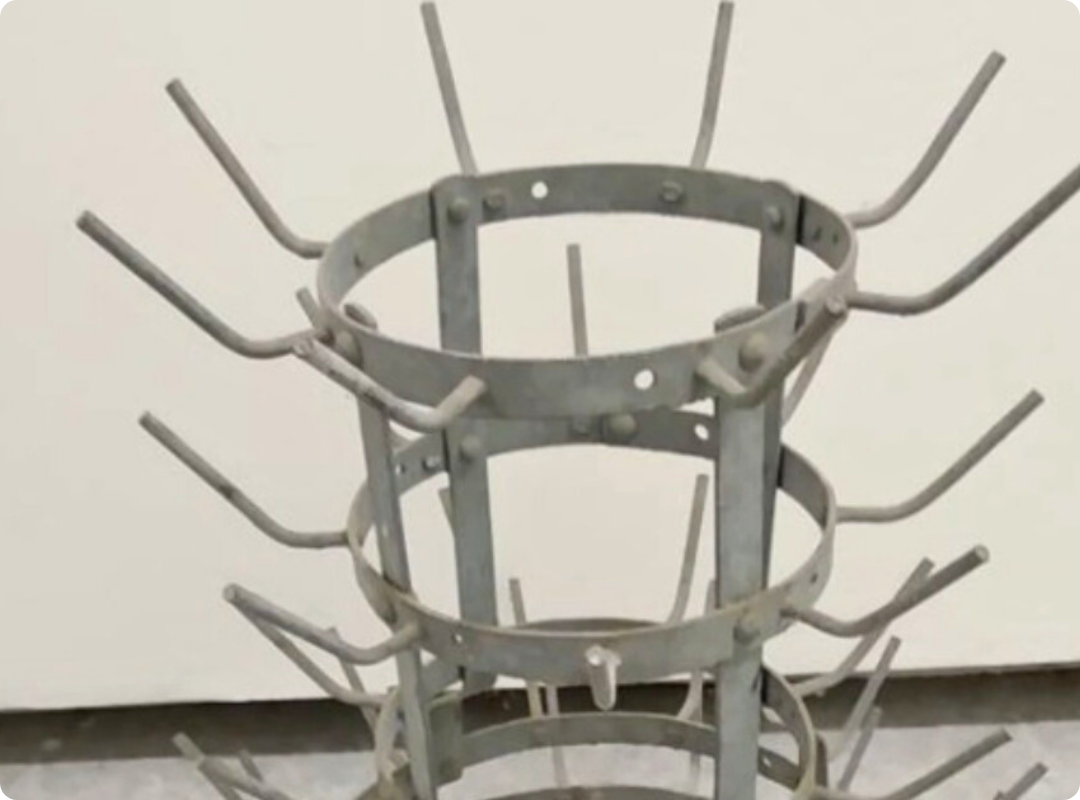
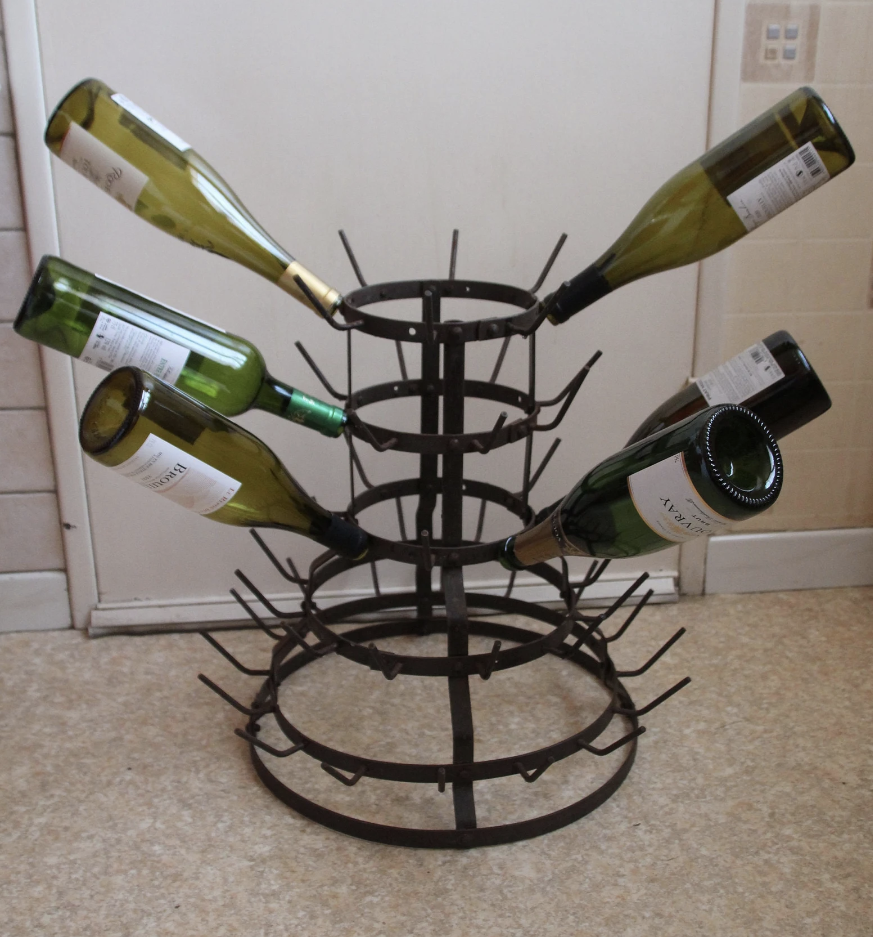
Known in France as a hérisson (“hedgehog”) for its spiky silhouette, or simply as a bottle tree in American farmhouses, this rack was engineering distilled to its essence. A wrought-iron or wire frame, crowned with slender prongs. Bottles—milk jars, canning vessels, beer bottles—slid upside down onto each spike, their open mouths cradled securely.
Gravity did the rest. Water pooled, then dripped cleanly away. Air circulated freely through the inverted cavity, banishing moisture where mold might otherwise take root. No electricity. No moving parts. Just physics, honored.
This wasn’t convenience—it was necessity. Before plastic, before disposability, families reused glass relentlessly. The morning’s milk bottle became tomorrow’s preserves jar. The beer bottle from Saturday’s gathering held Monday’s pickled beets. And between uses? It had to be impeccably clean, utterly dry. The rack ensured it was.
Sustainability Before the Word Existed
Decades before “reduce, reuse, recycle” became a mantra, these racks embodied its spirit. They were born not of ideology, but of thrift—a quiet understanding that resources were finite and waste was failure.
Glass wasn’t discarded; it was curated. Scrubbed with vinegar and baking soda. Rinsed in rainwater collected from the cistern. Dried on the rack until it gleamed, ready for its next life. This wasn’t minimalism. It was reverence—for materials, for labor, for the simple truth that a well-cared-for object could serve generations.
And with that care came skill. Families knew how to mend a cracked jar with beeswax, repurpose a broken bottle into a vase, or melt flawed glass into paperweights. The rack stood witness to this cycle—not as a relic of scarcity, but as proof of abundance born from respect.
The Choreography of Togetherness
In those kitchens, drying bottles wasn’t a solitary task. It was a ritual woven into the fabric of family life.
Children stood on step stools, carefully placing jars on the rack’s prongs—learning patience as they waited for each drop to fall. Grandmothers inspected the work, not with criticism, but with quiet pride. Fathers returned from the barn to find the rack full, a silent signal that the day’s preserving was complete.
These moments built more than clean bottles. They built connection. In the shared rhythm of rinse, invert, wait—families practiced cooperation without naming it. The rack, silent and steadfast, became a stage for lessons no textbook could teach: care for what you own, honor the work of others, and understand that even small tasks hold dignity.
From Function to Memory
Today, you might spot a vintage rack in a sun-drenched café, holding mugs instead of milk bottles. Or in a minimalist loft, its spiky silhouette casting delicate shadows on a white wall. Its purpose has shifted—but its soul remains.
It no longer dries the vessel that held last night’s tomato sauce. But it still whispers of slower mornings. Of hands that knew the weight of a well-used jar. Of a world where “disposable” was a foreign concept—and every object carried the imprint of those who cherished it.
Why This Matters Now
We live in an age of abundance that often feels like emptiness. We own more, yet keep less. We replace rather than repair. We rush through tasks that once held meaning.
The bottle drying rack offers no judgment—only invitation. To pause. To consider the life of the objects we use. To ask: Could this serve again? Could I care for it a little longer?
It reminds us that sustainability isn’t about sacrifice. It’s about attention. That resourcefulness isn’t born of lack—but of love for what we have. And that the most enduring tools aren’t those that save us time, but those that help us inhabit time more fully.
So the next time you see one—rust-pitted, silent, holding court in an antique shop—don’t just see metal and memory. See a philosophy made visible. A testament to the truth that the smallest acts of care, repeated daily, become the architecture of a meaningful life.
Some tools measure progress in speed. Others measure it in stillness. This one chose stillness—and in doing so, outlasted us all.