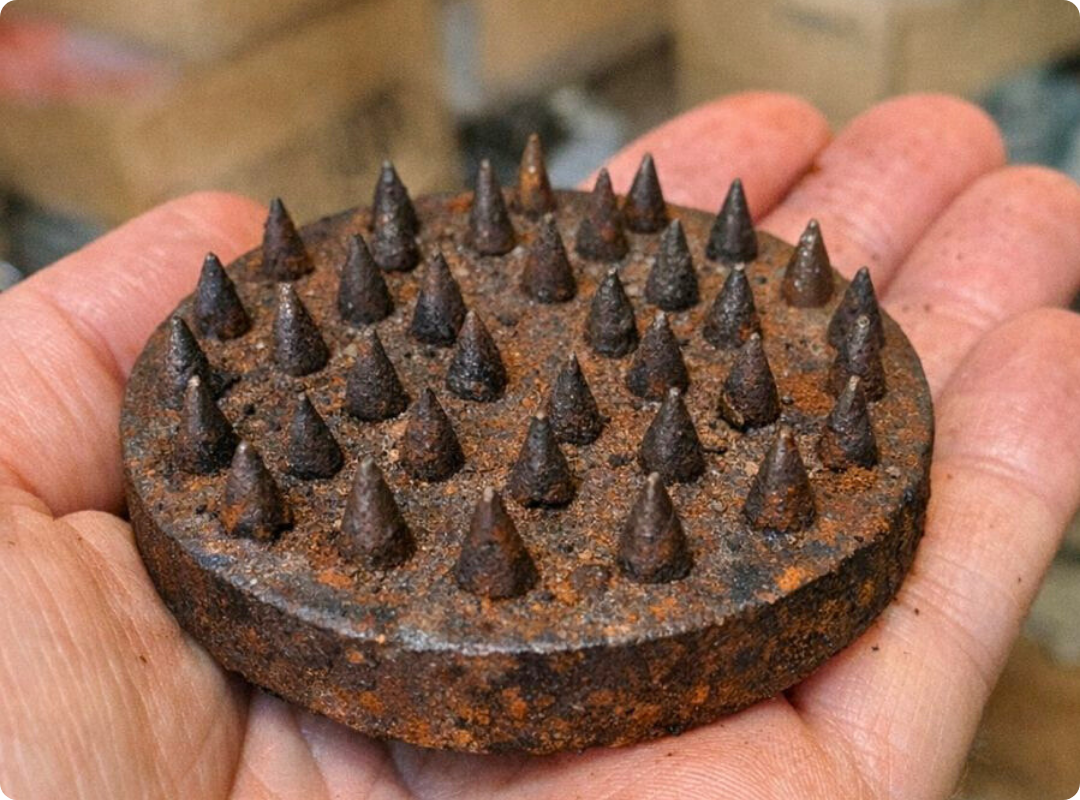
You’re sorting through decades of memories when your hand brushes against something unexpected—a heavy, cold disc bristling with sharp metal spikes. Rust blooms across its surface like a weathered map. For a heartbeat, your mind races: Medieval weapon? Industrial relic? Something best left buried?
But this object tells a gentler story. What you’ve found is likely a vintage flower frog—a forgotten artisan’s tool that once held bouquets in perfect, living symmetry. Let’s unravel its history, handle it safely, and rediscover the quiet artistry hidden in your attic.
⚠️ First Priority: Safety Before Curiosity
Rusted metal and sharp protrusions demand respect:
→ Wear thick gloves when handling—spikes typically measure ½–1 inch and can puncture skin.
→ Store securely away from children and pets until identified.
→ Check your tetanus vaccination status if handling extensively (rust itself doesn’t cause tetanus, but puncture wounds in soil-contaminated environments can).
→ Place on a stable surface—never leave unattended where someone might step on or brush against it.
→ Wear thick gloves when handling—spikes typically measure ½–1 inch and can puncture skin.
→ Store securely away from children and pets until identified.
→ Check your tetanus vaccination status if handling extensively (rust itself doesn’t cause tetanus, but puncture wounds in soil-contaminated environments can).
→ Place on a stable surface—never leave unattended where someone might step on or brush against it.
This isn’t danger—it’s dignity. Treat the object with care, and it will reveal its purpose without harm.
🌸 What Is a Flower Frog?
Despite its formidable appearance, this tool served beauty, not battle. A flower frog is a weighted base—traditionally cast iron, lead, or brass—studded with upright pins designed to secure flower stems within vases. Popular from the Victorian era through the 1950s, it was the florist’s secret weapon before floral foam existed.
How it worked:
- The frog settled in the bottom of a vase or shallow bowl.
- Stems were pressed between pins, locking blooms in precise arrangements.
- Water filled the vessel, nourishing flowers while the frog held stems upright for days.
The result? Structurally perfect bouquets—no wilting, no slumping, no rearranging. Just enduring elegance.
🔍 Confirming the Identification
Your object is likely a flower frog if it shows these traits:
✓ Uniform pin pattern – Spikes arranged in concentric circles or grids (not random)
✓ Weighted, flat base – Heavy enough to anchor arrangements (2–6 inch diameter typical)
✓ No threading or mechanical parts – Purely functional design, not an industrial component
✓ Possible markings – Faint stamps like “England,” “Japan,” or manufacturer names (e.g., “Summit”)
✓ Uniform pin pattern – Spikes arranged in concentric circles or grids (not random)
✓ Weighted, flat base – Heavy enough to anchor arrangements (2–6 inch diameter typical)
✓ No threading or mechanical parts – Purely functional design, not an industrial component
✓ Possible markings – Faint stamps like “England,” “Japan,” or manufacturer names (e.g., “Summit”)
Less likely alternatives:
• Weaponry – Lacks handles, blades, or intentional harm design
• Industrial part – No bolt holes, gears, or attachment points
• Decorative object – Too utilitarian; lacks ornamental flourishes
• Weaponry – Lacks handles, blades, or intentional harm design
• Industrial part – No bolt holes, gears, or attachment points
• Decorative object – Too utilitarian; lacks ornamental flourishes
📜 A Glimpse Into Floral History
Flower frogs thrived in an era when arranging was an art form. Before mass-produced foam, florists relied on these metal guardians to create:
→ Formal centerpieces for weddings and banquets
→ Ikebana-inspired compositions (Japanese frogs often featured minimalist pin patterns)
→ Church altar arrangements that needed to last through long services
→ Formal centerpieces for weddings and banquets
→ Ikebana-inspired compositions (Japanese frogs often featured minimalist pin patterns)
→ Church altar arrangements that needed to last through long services
Their decline began in the 1950s with the rise of oasis foam—but their legacy endures in vintage arrangements and the hands of traditional florists who still swear by their precision.
🕰️ Dating Your Discovery
Clues to age hide in plain sight:
|
Feature
|
Likely Era
|
|---|---|
|
Heavy cast iron/lead
|
Pre-1940s (denser metals)
|
|
Brass or copper base
|
1920s–1950s (Art Deco influence)
|
|
Japanese markings
|
1950s–1970s (post-war export boom)
|
|
Severe pitting/rust
|
50+ years old (if stored damp)
|
|
Ornate floral engravings
|
Victorian/Edwardian (pre-1920)
|
Note: Rust alone doesn’t indicate age—storage conditions matter more. A dry attic preserves metal; a damp basement accelerates decay.
💰 Collectible Value: More Than Rust
While common frogs sell for $5–$20, certain traits increase value:
✨ Japanese “kenzan” frogs (brass with fine pins) – $30–$150
✨ Signed English makers (e.g., “Summit,” “England”) – $40–$200
✨ Unusual shapes (hearts, stars, animals) – $50+
✨ Minimal rust + intact pins – Premium condition doubles value
✨ Japanese “kenzan” frogs (brass with fine pins) – $30–$150
✨ Signed English makers (e.g., “Summit,” “England”) – $40–$200
✨ Unusual shapes (hearts, stars, animals) – $50+
✨ Minimal rust + intact pins – Premium condition doubles value
Check Etsy, eBay, or antique shops for comparable sales. Most importantly: its true worth lies in the story it carries—a testament to hands that once arranged beauty with patience and precision.
🧤 Safe Handling & Restoration
To clean gently:
- Brush loose rust with a soft brass brush (never steel—too abrasive).
- Soak 15–30 minutes in equal parts white vinegar and water.
- Rinse thoroughly; dry completely with a soft cloth.
- Preserve with a light coat of museum wax or clear lacquer (test first on edge).
⚠️ Avoid:
→ Steel wool or sandpaper (scratches antique patina)
→ Prolonged soaking (weakens metal)
→ Harsh chemicals (can discolor or pit surface)
→ Steel wool or sandpaper (scratches antique patina)
→ Prolonged soaking (weakens metal)
→ Harsh chemicals (can discolor or pit surface)
For display:
→ Place in a shadowbox with a descriptive card
→ Use as a conversation-starting bookend
→ Repurpose as a unique jewelry holder (earrings dangle beautifully from pins)
→ Place in a shadowbox with a descriptive card
→ Use as a conversation-starting bookend
→ Repurpose as a unique jewelry holder (earrings dangle beautifully from pins)
♻️ When to Let Go
Discard only if:
→ Metal crumbles at the touch (advanced corrosion)
→ Pins are snapped/bent beyond function and display value
→ Rust harbors mold or poses genuine health risk
→ Metal crumbles at the touch (advanced corrosion)
→ Pins are snapped/bent beyond function and display value
→ Rust harbors mold or poses genuine health risk
Otherwise: recycle responsibly through metal scrap programs—never landfill. Even in retirement, its materials deserve respect.
That spiky disc in your attic isn’t a threat. It’s a quiet witness to afternoons spent arranging peonies in crystal bowls. To hands that understood how beauty requires both freedom and structure. To a time when a simple tool could transform wildflowers into poetry.
So clean it gently. Display it proudly. And the next time you pass it on your shelf, remember:
Some of the most beautiful things in life don’t shout their purpose.
They wait in stillness—
until someone curious enough to look closely
discovers the art hidden in plain sight
Some of the most beautiful things in life don’t shout their purpose.
They wait in stillness—
until someone curious enough to look closely
discovers the art hidden in plain sight