Few figures have reshaped our understanding of death as courageously—or compassionately—as Dr. Elisabeth Kübler-Ross. A pioneering psychiatrist and the author of the groundbreaking On Death and Dying, she didn’t just study the end of life—she walked alongside it, listening intently to those on its threshold. In doing so, she ventured beyond clinical observation into one of humanity’s oldest questions: What happens to the spirit when the body is cremated?
Far from offering speculation, Kübler-Ross grounded her views in decades of firsthand experience—thousands of conversations with the dying, meticulous documentation of near-death experiences (NDEs), and accounts from individuals who had been clinically dead and returned. From this vast well of human testimony, she arrived at a radical yet comforting conclusion: death is not an end, but a transition.
Consciousness Beyond the Body
According to Kübler-Ross, what many call the “spirit” or “consciousness” does not vanish with the last breath. Instead, it persists—often described by those who’ve glimpsed the other side as a state of profound peace, enveloping light, unconditional love, and reunion with departed loved ones. Many also report observing their own bodies from above, fully aware yet free from pain or fear.
This continuity of awareness suggests that consciousness is not dependent on the physical form. It exists independently—and often departs the body well before biological processes like cremation begin.
Cremation: A Ritual for the Living, Not the Departed
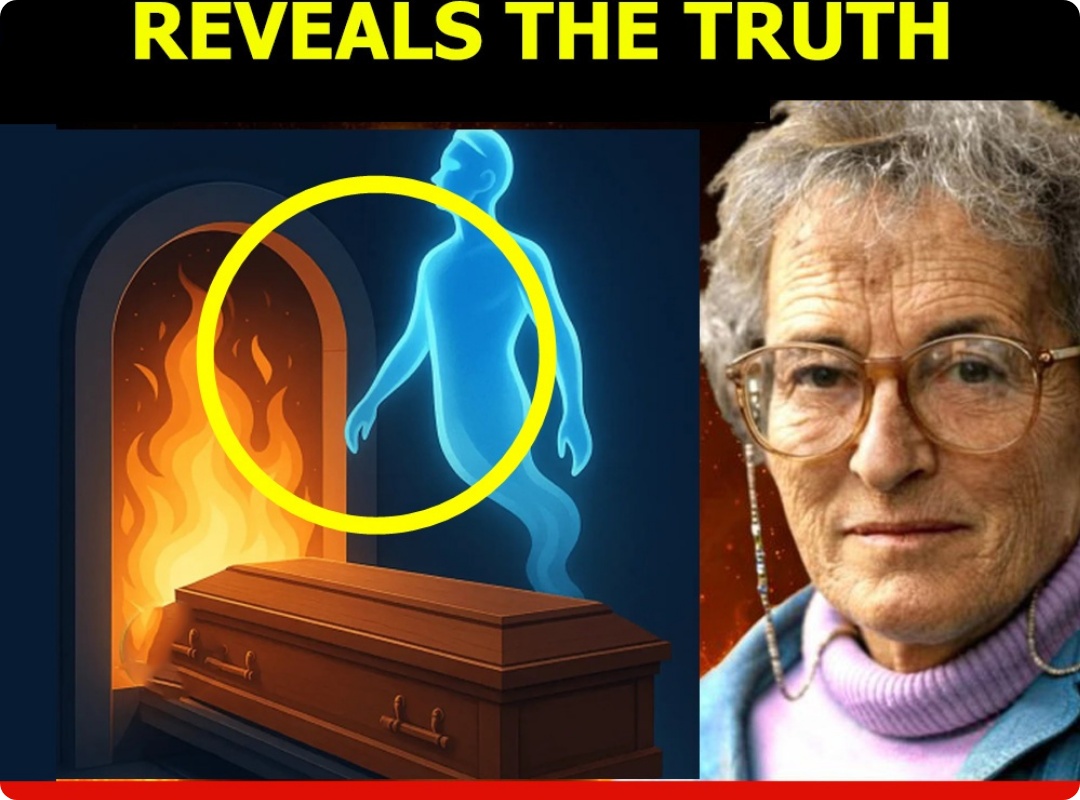
Cremation, Kübler-Ross emphasized, is purely a physical transformation: fire reduces the body to ash, returning its elements to the earth. But the essence of the person—their consciousness, spirit, or vital energy—has already moved on.
She likened this separation to a butterfly emerging from its chrysalis: the shell remains, but the living being has already taken flight.
In her view:
- The body fulfills its earthly purpose and may be honored through burial or cremation—both are cultural choices.
- The spirit, however, is already journeying beyond the material realm.
- Cremation cannot harm, delay, or alter the spirit, because consciousness has already disengaged from the physical form.
Thus, the act of cremation is not a moment of spiritual consequence—but a symbolic gesture of closure for those left behind.
Death as Transition, Not Termination
For Kübler-Ross, death was never a void. Instead, it was a profoundly meaningful passage, often experienced with startling clarity and serenity. Those who returned from clinical death consistently described similar themes:
- An overwhelming sense of peace
- The absence of physical pain
- Encounters with luminous beings or beloved ancestors
- A deep, wordless knowing of universal love
These shared narratives led her to believe that consciousness can perceive reality even after the heart stops and the brain falls silent. The separation from the body isn’t loss—it’s liberation into a broader, more expansive state of being.
In the eyes of Elisabeth Kübler-Ross, cremation is neither threat nor obstacle to the soul. It is simply the final care we offer the vessel that once carried a life. The true self—the enduring spark of awareness—has already stepped into the next dimension, unburdened and whole.
Her message offers solace: whether buried or burned, the body is only a temporary home. The spirit? It was never confined by it. And in that truth lies both mystery and peace.